To access these reports, navigate to your Products tab and click the report icon for your desired product. This opens the Impact Report Overview, which displays the PEF report by default.
To switch to the GHG Protocol assessment, select GHG in the dropdown at the top of the page. The resulting dashboard shows estimated Scope 1, 2, and 3 emissions specific to the product.
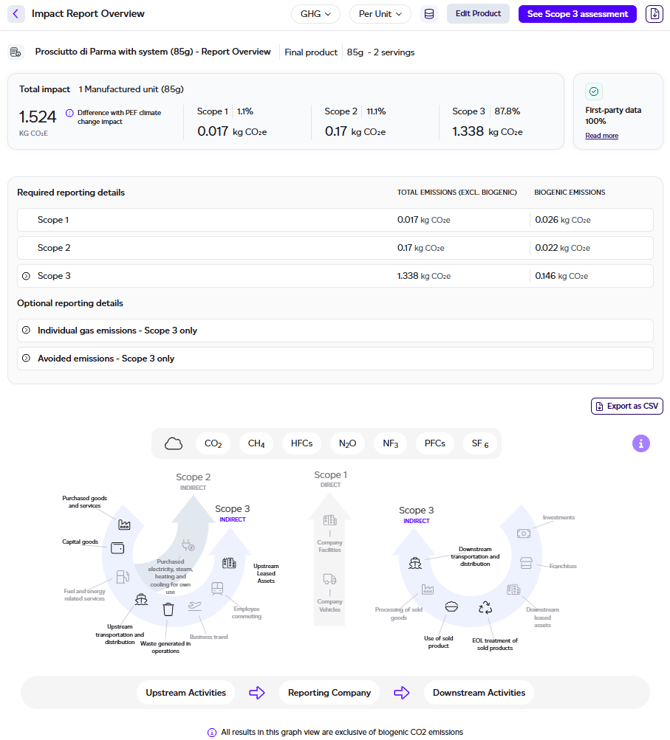
Important limitation: This assessment covers only product-related emissions and should not be considered a complete organisational Scope 1, 2, and 3 evaluation. Scope 1 and 2 calculations rely primarily on secondary data and are intended for reference purposes only.
Dashboard Components
The GHG Protocol dashboard provides:
- Product Overview — Name, net amount, servings, and product type.
- Total Estimated Emissions — Overall emissions plus scope breakdown in kg CO2e and percentages.
- First Party Data level — Status indicator showing whether the product is incomplete, uses default assumptions, or achieved 100% first-party data.
- Scope 1/2/3 Breakdown — Detailed emissions by scope with expandable subcategories, including biogenic emissions reported separately.
- Optional reporting — Individual gas emissions and avoided emissions from recycling.
- GHG Protocol Graph — Visual representation across all in-scope categories.
You can export this data as CSV by clicking the export button.
Accessing Detailed Reports
Click 'See Scope 3 Assessment' to view the comprehensive report. This detailed version is only available when your product contains 100% first-party data. Products below this threshold will display a warning about unmet screening LCA thresholds.
The detailed report mirrors the PEF Report structure but replaces the LCIA tab with a Results section containing the GHG Protocol graph and scope breakdown table. Additional appendices cover Global Warming Potential Factors and Organisational Boundaries Assumptions.