
Sustainability & ESG
You own the number and the target. Sustained builds both from the products, so every corporate figure traces to an ingredient, an origin and a named dataset.
The three questions a board, a retailer and an auditor will ask you this year.
“What is our Scope 3 from the products we make, and how good is that number?”
A bottom-up inventory from production volumes times product footprints, with a computed data-quality rating on every product and a first-party data share surfaced everywhere.
“Are we on track for the target we committed to?”
A fixed-year baseline, targets per category or overall, historical actuals and a forecast from the production plan. Progress tracking says on track or insufficient.
“What could we file today, and what is not assessed yet?”
Five disclosure-readiness chips earned from your data: PEF, CSRD ESRS E1, SBTi, GHG scopes, TCFD. Each is earned or marked not assessed; none is assumed. Then the climate disclosure pack: one workbook per period, laid out for the GHG Protocol, SBTi FLAG, CDP 7.8, ESRS E1 and VSME, with a WRAP Scope 3 conformance sheet. The workbook your disclosure is filled from, not a filing.
Report, share, and know what the climate is doing to the supply chain.

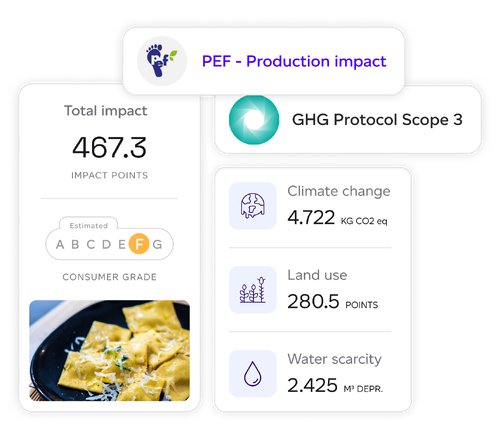
The ESG lens: the footprint in CO₂e, impact categories, data quality, first-party data, and where the impact comes from.
At workspace and company scope. The company dashboard rolls every workspace into one canonical view, with the volume and baseline block a group sustainability lead needs and the readiness chips beside it. Disclosure readiness and the climate disclosure pack sit one tab away.
- PEF impact categories and the footprint by product category, product to portfolio, with a map of where the impact comes from
- Data-quality rating aggregated across the portfolio, with the lines that pull it down
- Disclosure readiness: PEF, CSRD E1, SBTi, GHG scopes, TCFD, and the workbooks under Disclosures
- AI insight cards where every figure is in the evidence beside it
“This works for one product, but we have ~4,000 SKUs across the group. We realised quite quickly that manual LCA wasn't going to scale.”

Where to start
Footprinting with the GHG add-on, then Action & Mitigation
The production baseline, historical and forecast footprints are in Footprinting. GHG Protocol reporting, Scope 1, 2 and the product-relevant Scope 3 categories with a corporate GHG inventory, the climate disclosure pack and PACT footprint exchange, is the corporate GHG footprinting add-on, available on either package and included in the figure here. Targets, progress tracking and the AI reduction agent are Action & Mitigation. All online today.
From
£1,215
per year · 1 user, 10 products, with the GHG add-on · Action & Mitigation from £1,573 on the same basis