Two Frameworks, One Planet
The Product Environmental Footprint (PEF) method evaluates products across 16 environmental impact categories, providing a granular view of a product's environmental performance. The Planetary Boundaries framework, introduced by Johan Rockström and colleagues in 2009, takes a fundamentally different perspective — defining the safe operating space for humanity by identifying nine critical Earth-system processes and their thresholds.
Understanding how these two frameworks relate is essential for anyone who wants to move beyond product-level metrics and understand what their LCA results mean for the planet.
The Nine Planetary Boundaries
The Planetary Boundaries framework identifies nine processes that regulate the stability and resilience of the Earth system:
- Climate Change — atmospheric CO2 concentration and radiative forcing
- Biosphere Integrity — genetic diversity and functional diversity
- Land-System Change — proportion of global land cover converted to cropland
- Freshwater Use — global consumptive water use
- Biogeochemical Flows — nitrogen and phosphorus cycles
- Ocean Acidification — carbonate ion concentration in surface seawater
- Atmospheric Aerosol Loading — aerosol optical depth
- Stratospheric Ozone Depletion — stratospheric ozone concentration
- Novel Entities — release of synthetic chemicals, plastics, and other novel materials
Seven Boundaries Transgressed
As of the latest scientific assessments, seven of these nine boundaries have been transgressed. Climate Change, Biosphere Integrity, Land-System Change, Freshwater Use, Biogeochemical Flows, Novel Entities, and Atmospheric Aerosol Loading all exceed their safe operating thresholds. Only Ocean Acidification and Stratospheric Ozone Depletion remain within safe limits.
How Planetary Boundaries Relate to LCA
The PEF method and the Planetary Boundaries framework operate at different scales — product-level versus planetary — but they share a common scientific foundation. Many PEF impact categories directly correspond to planetary boundary processes, which means that product-level LCA results can be interpreted in the context of Earth-system thresholds.
This connection is powerful because it transforms abstract impact scores into something more tangible: a product's contribution to transgressing the boundaries that define a safe operating space for humanity.
Technical Appendix: Boundary Definitions and Thresholds
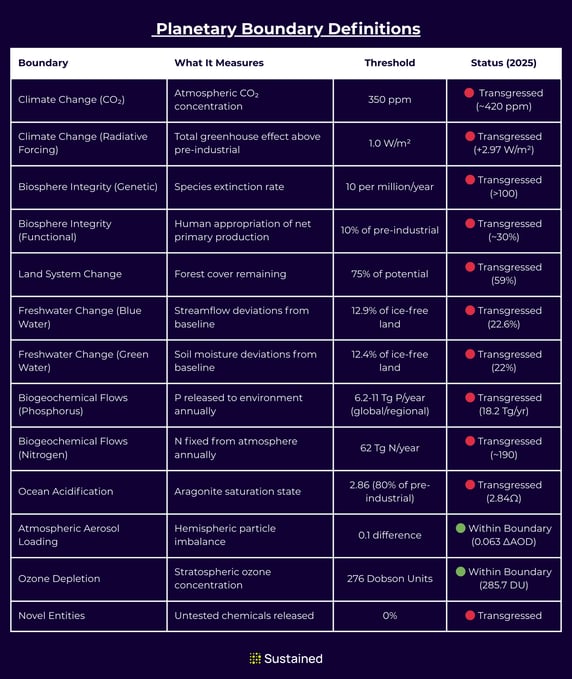
- Climate Change: Pre-industrial CO2 was 280 ppm; the boundary is set at 350 ppm; current levels exceed 420 ppm
- Biosphere Integrity: Measured as species extinction rate; boundary set at 10 E/MSY (extinctions per million species-years); current rate exceeds 100 E/MSY
- Land-System Change: Boundary at 75% of original forest cover remaining; currently at approximately 62%
- Freshwater Use: Boundary at 4,000 km3/year consumptive use; current levels approaching 2,600 km3/year but with severe regional transgressions
- Biogeochemical Flows (N): Boundary at 62 Tg N/year; current industrial fixation exceeds 150 Tg N/year
- Biogeochemical Flows (P): Boundary at 11 Tg P/year flow to oceans; current levels approximately 22 Tg P/year
- Ocean Acidification: Boundary at ≥80% of pre-industrial aragonite saturation; currently at approximately 84%
- Stratospheric Ozone Depletion: Boundary at 275 DU; currently recovering toward this threshold
- Novel Entities: No single quantitative threshold; assessed as transgressed based on the scale and persistence of synthetic chemical releases