The Data Challenge
The single biggest challenge in Life Cycle Assessment is access to primary data — the specific, measured data from your actual supply chain operations. No company, regardless of size or resources, can audit its entire supply chain from raw material extraction to end-of-life. The supply chains of food and beverage products are simply too complex, too fragmented, and too dynamic.
This means that every LCA involves a blend of primary data (from your own operations and direct suppliers) and secondary data (from databases like Ecoinvent, Agribalyse, or WFLDB that represent industry averages or modelled processes). The question is not whether to use secondary data, but how to find the right balance.
Finding the Right Balance
The appropriate mix of primary and secondary data depends on the purpose of the assessment and where you are in your sustainability journey.
Screening and Internal Use
For initial portfolio screening — identifying hotspots, prioritising action areas, and building internal understanding — secondary data is often sufficient. A screening LCA using high-quality secondary data can reveal which products, ingredients, and processes merit deeper investigation, allowing you to focus primary data collection where it will matter most.
Improving What You Control
Primary data delivers the most value for processes you directly control: your own manufacturing operations, energy use, waste generation, and direct logistics. This is where primary data is most readily available and where it most directly informs operational improvement.
Engaging Suppliers
For upstream supply chain stages — agricultural production, ingredient processing, packaging manufacturing — primary data requires supplier engagement. This is a gradual process:
- Start with your highest-impact suppliers (those providing ingredients identified as hotspots in screening assessments)
- Request specific, verifiable data points rather than comprehensive LCI datasets
- Build capability over time, recognising that data quality will improve iteratively
Reporting and Compliance
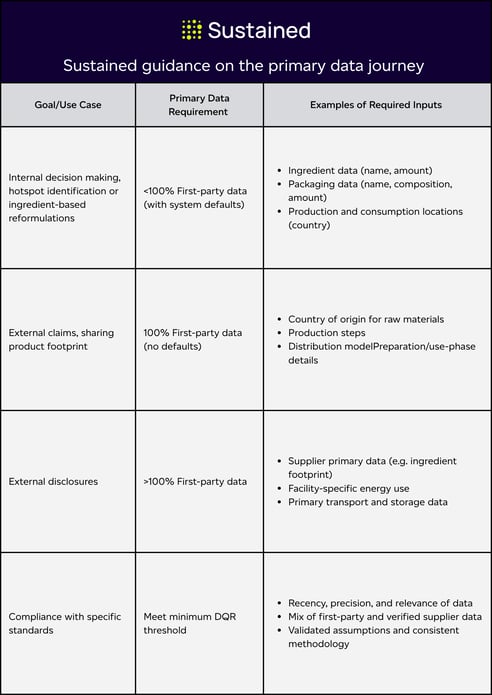
For external reporting and regulatory compliance, data quality requirements are more stringent. The PEF method includes Data Quality Rating (DQR) requirements that assess the temporal, geographical, and technological representativeness of data used. Meeting these requirements typically demands a higher proportion of primary data for foreground processes.
A Pragmatic Path Forward
The most effective approach is iterative:
- Screen broadly with secondary data to understand your portfolio
- Prioritise primary data collection for highest-impact areas
- Engage suppliers progressively, starting with the most material contributors
- Improve continuously as data availability and quality increase over time
Perfection is not the goal. Informed decision-making is. A well-constructed LCA using a thoughtful blend of primary and secondary data is far more valuable than no assessment at all — and far more practical than waiting until every data point is measured directly.